10 Medium Killer Sudoku Vol.5: A Practical Resource for Puzzles and Publishing
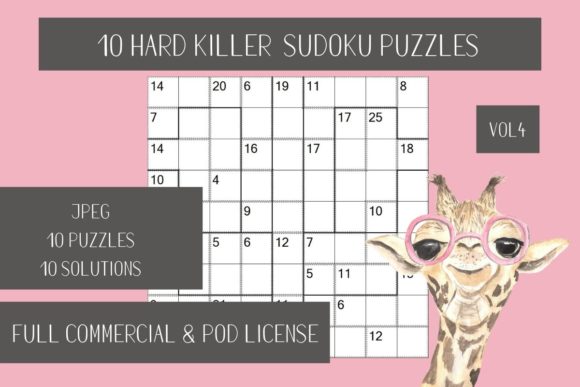
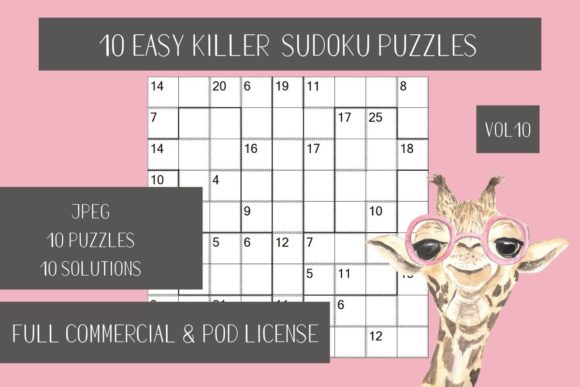
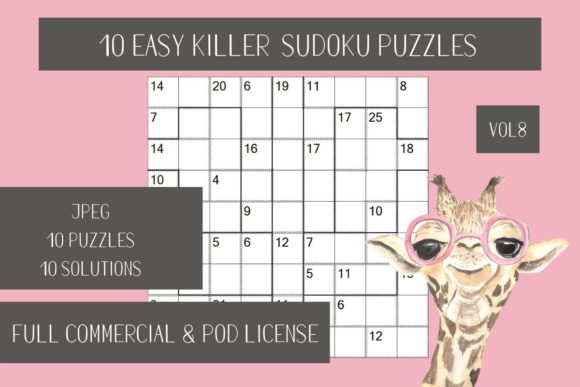
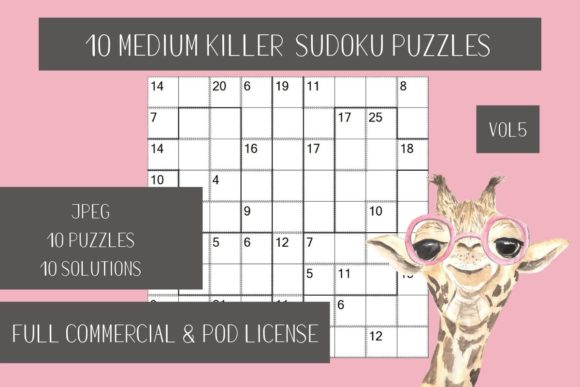
In the expansive world of logic puzzles, Killer Sudoku occupies a unique niche that bridges traditional number placement with arithmetic reasoning. For content creators, activity book publishers, and dedicated puzzle enthusiasts, sourcing high-quality, ready-to-use assets is often a significant hurdle. 10 Medium Killer Sudoku Vol.5 addresses this specific need by providing a curated collection of medium-difficulty puzzles designed for both personal enjoyment and commercial application. This resource is not merely a set of games; it is a functional asset pack tailored for those who require clean, professional-grade materials without the friction of creating them from scratch.
Understanding the Medium Difficulty Sweet Spot
When evaluating puzzle resources, difficulty calibration is paramount. "Medium" in the context of Killer Sudoku is a distinct category that differs significantly from standard Sudoku or extreme-level math puzzles. In 10 Medium Killer Sudoku Vol.5, the medium designation implies a balance where logical deduction takes precedence over exhaustive trial and error. Solvers must utilize cage sums and the 45-rule effectively, but the path to solution remains accessible to intermediate players without requiring advanced combinatorial analysis.
This level of difficulty is strategically valuable for several reasons:
- Retention: Puzzles that are too easy lead to boredom, while those that are too hard cause frustration. Medium puzzles maintain the "flow state" essential for engagement.
- Versatility: They appeal to a broad demographic, from teenagers developing logic skills to adults seeking cognitive maintenance.
- Pacing: For activity books, medium puzzles provide the perfect filler between introductory tutorials and challenge sections.
For creators incorporating these into larger projects, understanding this balance ensures that the end product meets audience expectations. The puzzles in this volume have been vetted to ensure they adhere to these medium-level parameters, saving creators from the time-consuming process of playtesting and re-calibrating difficulty.
Technical Specifications and Asset Quality
The utility of any digital puzzle asset lies in its technical execution. 10 Medium Killer Sudoku Vol.5 is delivered as a set of JPEG files with specific dimensions: 892×892 pixels at 96 dpi. Understanding these specifications is crucial for determining how best to utilize the files in various workflows.
Resolution and Print Considerations
At 892×892 pixels, these images offer a square aspect ratio ideal for grid-based puzzles. When printed at their native resolution, they produce crisp lines suitable for standard activity books, worksheets, and newsletters. However, users should be mindful of the 96 dpi specification. While this resolution is excellent for digital viewing, screen-based apps, and standard home printing, professionals preparing high-end glossy publications may need to consider vectorization or upscaling techniques if printing at very large physical sizes. For the vast majority of KDP (Kindle Direct Publishing), Etsy digital downloads, and classroom handouts, however, this resolution hits the optimal balance between file size and visual clarity.
The Value of Watermark-Free Assets
One of the most significant features of this collection is the absence of watermarks on both the puzzle and solution files. In the creative economy, watermark-free assets are non-negotiable for commercial use. Watermarks disrupt the user experience and render an image unusable for professional publishing. By providing clean files, 10 Medium Killer Sudoku Vol.5 allows business owners and creators to integrate these puzzles directly into their products without additional editing or licensing concerns. This streamlines the production pipeline, reducing the time from acquisition to publication.
Applications for Creators and Business Owners
The primary value proposition of this volume extends beyond simple entertainment. It serves as a foundational building block for various commercial and educational ventures. Here is how different user groups can leverage these assets effectively:
Self-Publishing and Activity Books
For authors publishing on platforms like Amazon KDP or IngramSpark, content volume is key. Creating original Killer Sudoku puzzles is mathematically complex and time-consuming. This 10-puzzle set acts as a modular component. Creators can combine multiple volumes to build full-length books or use them as bonus content to increase perceived value. Because the files include solutions, the back-matter of the book is essentially pre-formatted, significantly reducing layout time.
Educational Resources and Tutoring
Educators and tutors focusing on STEM enrichment often seek materials that make arithmetic engaging. Killer Sudoku is superior to standard Sudoku for math education because it requires addition and subtraction within the solving process. Teachers can print these 892×892 px files directly onto standard paper for classroom activities. The medium difficulty is particularly appropriate for middle school students or adult learners in cognitive therapy settings, providing a challenge that reinforces number bonds without being discouraging.
Digital Content and Apps
App developers and website owners can use these JPEGs as static content or as reference designs for UI development. The clean aesthetic and standard sizing make them easy to implement in blog posts, email newsletters, or membership sites offering daily brain teasers. The inclusion of separate solution files allows for interactive web elements where users can toggle answers or verify their work instantly.
Evaluating Suitability for Your Project
While 10 Medium Killer Sudoku Vol.5 is a robust resource, potential users should evaluate its fit for their specific needs. Transparency regarding limitations and strengths ensures better project outcomes.
Strengths
- Immediate Usability: No conversion or cleanup is required. Files are ready to drop into InDesign, Canva, or Word.
- Consistent Styling: All 10 puzzles share a uniform visual language, which is critical for maintaining a professional look in published books.
- Verified Solutions: Every puzzle comes with a corresponding solution file, eliminating the risk of publishing unsolvable or erroneous grids.
Considerations and Limitations
Users should note that JPEG is a raster format. Unlike SVG or EPS files, these images cannot be infinitely scaled without potential quality loss. If your project requires billboard-sized prints or extensive color manipulation, you may need to trace these assets. Additionally, because these are pre-generated puzzles, they are not exclusive; other creators may also own this volume. For brands requiring proprietary, unique content, these should be used as supplementary material rather than the sole selling point. However, for general activity books and educational supplements, this non-exclusivity rarely impacts market performance.
Best Practices for Implementation
To maximize the value of these assets, consider the following practical guidance when integrating them into your workflow:
- Test Print Before Publishing: Always print a sample page at your intended final size. Verify that the cage lines are distinct and the numbers are legible. The 892px dimension is generous, but verifying contrast on your specific printer prevents costly reprints.
- Mix with Narrative Content: If building an activity book, intersperse these puzzles with tips, fun facts about Sudoku history, or strategy guides. This adds original value to the purchased asset and enhances the reader's experience.
- Organize Your Asset Library: Keep the puzzle and solution files paired in your project folders. Renaming them sequentially (e.g., KillerSudoku_V5_01_Puzzle.jpg and KillerSudoku_V5_01_Solution.jpg) prevents layout errors during the compilation phase.
- Leverage for Marketing: Use one puzzle from the set as a free lead magnet or social media engagement post. The medium difficulty is perfect for this, as it encourages comments and shares from followers attempting to solve it.
The Cognitive and Recreational Value
Beyond the technical and commercial aspects, it is worth reiterating why Killer Sudoku remains a staple in the puzzle community. Unlike crosswords which rely on vocabulary, or standard Sudoku which relies purely on spatial logic, Killer Sudoku engages the brain’s numerical processing centers simultaneously with logical deduction. This dual-task requirement makes it a potent tool for neuroplasticity.
For the end-user solving a puzzle from 10 Medium Killer Sudoku Vol.5, the experience is one of structured discovery. The medium difficulty ensures that the solver feels a sense of agency and accomplishment. There is no guessing involved in a well-constructed medium Killer Sudoku; every step is a logical consequence of the previous one. This reliability builds trust between the puzzle creator and the solver. When you provide these puzzles to an audience, whether in a classroom, a bookstore, or a website, you are offering a guaranteed moment of focused, satisfying mental engagement.
Final Thoughts on Asset Selection
Selecting the right puzzle assets is a decision that impacts both production efficiency and end-user satisfaction. 10 Medium Killer Sudoku Vol.5 represents a pragmatic solution for those who need reliable, medium-difficulty content without the overhead of custom generation. Its specifications—892×892 px JPEGs at 96 dpi—are optimized for the modern hybrid workflow of digital and print publishing. The inclusion of watermark-free solutions further cements its utility for professionals.
Whether you are compiling a holiday activity book, designing a math curriculum, or simply looking to expand your personal puzzle archive, understanding the specific attributes of this volume allows you to deploy it effectively. By matching the asset’s strengths to your project’s requirements, you ensure that the final product is not only visually professional but also genuinely engaging for the solver. In the competitive landscape of puzzle publishing and education, such attention to detail and resource quality is what distinguishes successful projects from mediocre ones.