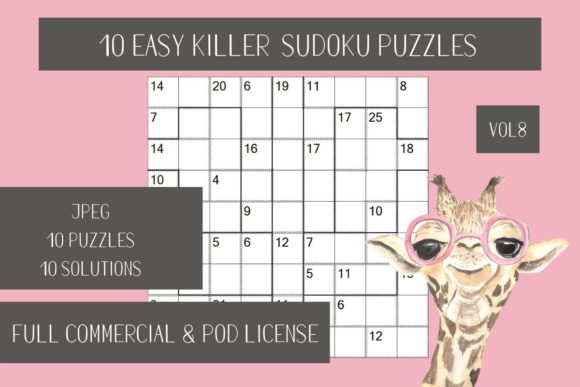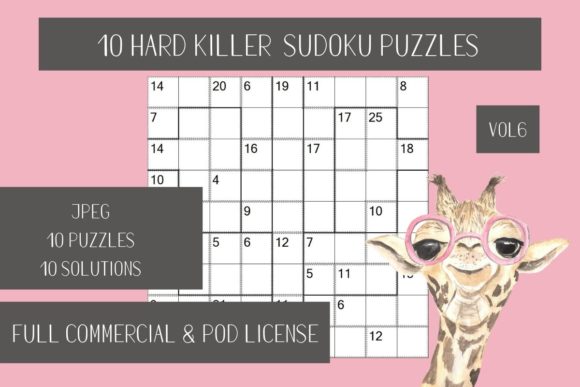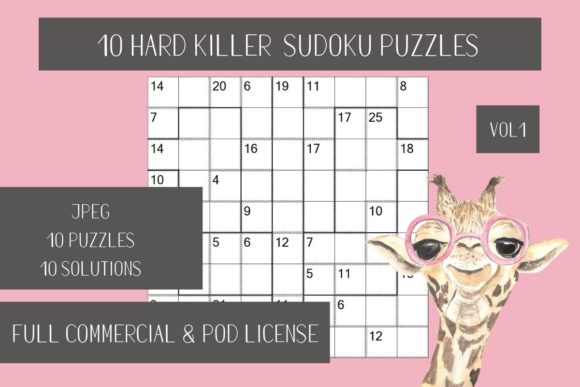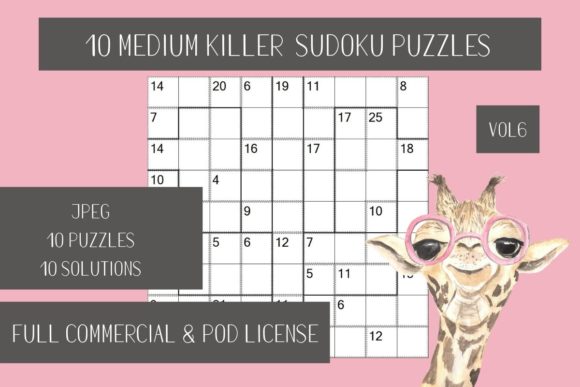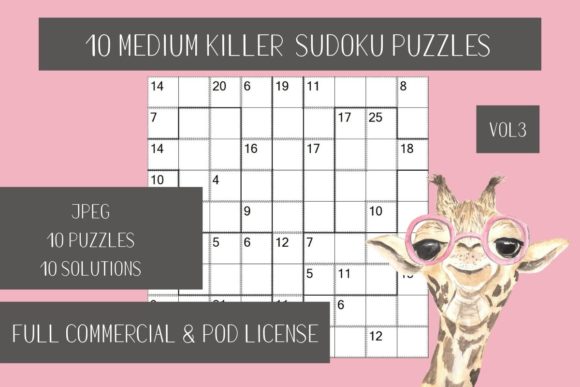
Evaluating 10 Medium Killer Sudoku Vol.2 for Activity Books and Personal Practice
Selecting the right puzzle content requires balancing difficulty, technical specifications, and licensing flexibility. For creators compiling activity books or enthusiasts seeking printable challenges, 10 Medium Killer Sudoku Vol.2 represents a specific niche within the logic puzzle market. Unlike standard Sudoku, which relies solely on number placement, Killer Sudoku integrates arithmetic constraints through "cages." This volume targets the medium difficulty spectrum, providing a bridge between introductory patterns and expert-level grid analysis. Understanding the specific attributes of this asset pack helps determine if it aligns with your production needs or personal solving preferences compared to other available formats.
Defining the Medium Difficulty Threshold
The term "medium" varies significantly across publishers and platforms. In the context of 10 Medium Killer Sudoku Vol.2, this classification generally implies puzzles that require more than simple single-cage deductions but do not necessitate complex bifurcation or exhaustive candidate tracking. Solvers should expect to use cage sum combinations, innie/outie techniques, and basic intersection logic. This distinguishes the set from "Easy" volumes, where cages often contain only one or two cells with obvious sums, and "Hard" volumes, where large cages span multiple nonets requiring advanced mental math.
For activity book creators, this distinction is critical. If your target audience includes casual solvers or those transitioning from classic Sudoku, this medium tier offers an appropriate challenge curve. It avoids the frustration of expert puzzles while preventing the boredom associated with repetitive easy grids. However, if you are curating a collection specifically for competitive speed solvers or tournament preparation, this volume may serve better as a warm-up resource rather than primary training material. Evaluating sample grids against your specific audience's skill baseline is always recommended before bulk integration.
Technical Specifications for Print Production
Digital assets must meet rigorous standards to translate effectively to physical media. This package provides files at 892×892 pixels with a resolution of 96 dpi. When comparing this to industry standards for commercial publishing, several practical considerations emerge:
- Resolution Context: Traditional offset printing typically demands 300 dpi. At 96 dpi, these images are optimized for digital viewing, web-based activity sheets, or print-on-demand services that utilize digital toner technology rather than traditional plates. They render crisply on screens and home printers but may show pixelation if scaled up significantly for large-format books.
- Dimensions: The square 892×892 px format is versatile. It fits comfortably within standard 8.5x11 inch or A4 layouts with ample margin space for binding and annotations. This aspect ratio eliminates the need for cropping or stretching, preserving the geometric integrity of the grid.
- File Format: JPEG delivery ensures broad compatibility with layout software like Canva, InDesign, or Affinity Publisher. While vector formats (SVG/EPS) offer infinite scalability, high-quality JPEGs remain the standard for many digital-first creators due to smaller file sizes and ease of handling.
Creators comparing this to vector-based alternatives should weigh the tradeoff: vectors allow unlimited resizing but often require manual adjustment of line weights and font sizes. These rasterized JPEGs provide a consistent, pre-formatted appearance that reduces layout time, provided the final print size remains within the optimal resolution range.
Licensing and Commercial Utility
A primary differentiator for 10 Medium Killer Sudoku Vol.2 is the absence of watermarks and the inclusion of commercial usage rights for activity books. Many free or low-cost puzzle generators embed branding or restrict redistribution, rendering them unsuitable for monetized projects. This asset pack removes those barriers, allowing direct integration into KDP interiors, Etsy printables, or classroom worksheets.
When evaluating this against subscription-based puzzle APIs or custom commission services, consider the cost-per-unit model. Subscription services offer volume but may lack exclusivity; thousands of users might access identical grids. Custom commissions guarantee uniqueness but carry higher upfront costs and longer turnaround times. This pre-made pack occupies a middle ground: immediate availability and clean licensing at a fixed price point, though without the bespoke customization of hired designers. For creators needing reliable filler content or supplementary pages rather than flagship unique puzzles, this balance often proves efficient.
Killer Sudoku vs. Classic Sudoku: Audience Fit
Understanding when to deploy Killer Sudoku versus classic variants helps optimize user engagement. Classic Sudoku tests pure logical deduction and pattern recognition. Killer Sudoku adds an arithmetic layer, engaging different cognitive pathways. 10 Medium Killer Sudoku Vol.2 serves audiences who enjoy mathematical reasoning alongside spatial logic.
Consider these comparative use cases:
- Educational Settings: Killer Sudoku reinforces addition skills and number partitioning. For teachers or homeschoolers creating math enrichment materials, this variant offers dual-purpose utility that classic Sudoku cannot match.
- Cognitive Maintenance: Adults seeking brain training often benefit from varied stimuli. Alternating between classic and Killer grids prevents skill plateauing. This volume provides ready-made variety for mixed-puzzle compilations.
- Niche Appeal: While classic Sudoku has broader mainstream recognition, Killer Sudoku attracts dedicated enthusiasts willing to pay premium prices for specialized content. Including this variant can differentiate an activity book in a saturated marketplace.
However, if your audience consists primarily of seniors with mild cognitive impairment or young children still developing arithmetic fluency, classic Sudoku or simplified picture puzzles may be more appropriate. Killer Sudoku’s dual-constraint nature increases cognitive load, making it less suitable for therapeutic relaxation contexts where low-friction engagement is the goal.
Assessing Value Against Alternative Sources
The decision to acquire this specific pack should factor in available alternatives. Free online generators can produce unlimited Killer Sudoku grids, but they often come with limitations: inconsistent difficulty labeling, embedded ads or watermarks, restrictive licenses, or variable visual quality. Professional puzzle designers charge significantly more for custom work but deliver tailored difficulty curves and exclusive content.
10 Medium Killer Sudoku Vol.2 positions itself as a curated, production-ready solution. The value proposition lies in consistency and cleanliness. Each puzzle maintains uniform styling, verified solutions, and appropriate medium-level complexity. For creators who lack the time to vet free generator outputs or the budget for custom design, this pack reduces friction. The inclusion of separate solution files further streamlines the production workflow, eliminating the need to solve puzzles manually for answer keys.
Conversely, if you require hundreds of puzzles for a high-volume publication, purchasing individual 10-puzzle packs becomes economically inefficient compared to bulk libraries or generator subscriptions. This volume works best as a targeted supplement, a tester for audience response, or a component of a larger curated collection where quality control matters more than sheer quantity.
Practical Integration Strategies
To maximize the utility of these assets, consider how they complement existing content. When building an activity book, intersperse Killer Sudoku grids among word searches, mazes, or classic Sudokus to create rhythmic variation. The medium difficulty level makes these puzzles suitable for mid-book placement—challenging enough to maintain interest after initial warm-ups, but not so demanding as to cause abandonment before the final pages.
For digital distribution, the 96 dpi resolution displays excellently on tablets and e-readers. Users can zoom without significant degradation, making these files suitable for interactive PDFs or app-based puzzle platforms. If offering print-at-home options, include a note recommending standard letter/A4 sizing to preserve clarity. Testing prints on common home printers before release helps identify any potential contrast issues with cage boundaries or digit legibility.
Ultimately, 10 Medium Killer Sudoku Vol.2 serves a specific function within the broader puzzle ecosystem. It is neither a comprehensive library nor a bespoke masterpiece, but rather a reliable, professionally formatted component for creators and solvers who value immediate usability and appropriate challenge levels. By understanding its technical parameters, licensing terms, and audience fit relative to alternatives, you can make an informed decision about its role in your projects or practice routine. The absence of watermarks and inclusion of solutions remove common friction points, allowing focus to remain on content quality and solver experience rather than asset management logistics.