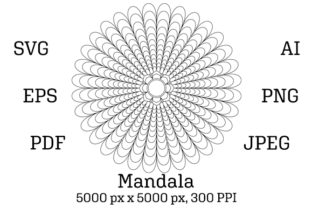
Mandala 04: Integrating High-Resolution Vector Assets into Commercial Creative Workflows
In the competitive landscape of Print on Demand (POD) and digital publishing, the quality of source assets dictates the ceiling of product viability. Mandala 04 represents more than a standalone decorative element; it functions as a foundational component within a broader production ecosystem designed for scalability and commercial application. For creators, publishers, and entrepreneurs operating in the KDP or merchandise space, this asset bridges the gap between artistic intent and technical manufacturing requirements. Its inclusion in a workflow is not merely about aesthetic selection but about securing a versatile, legally cleared resource that streamlines the path from concept to final output.
The value of Mandala 04 lies in its specific technical configuration and licensing structure. Sized at 5000 px by 5000 px at 300 PPI, it meets the rigorous resolution standards required for professional printing without upscaling artifacts. The provision of multiple file formats—AI, PNG, JPEG, SVG, EPS, and PDF—ensures compatibility across diverse software environments, from Adobe Illustrator to Canva and specialized RIP software. Furthermore, the Commercial Use License with full POD usage rights removes legal friction, allowing professionals to focus on execution rather than compliance verification. Understanding how to leverage these specifications effectively transforms a simple design purchase into a strategic business asset.
Technical Specifications and Manufacturing Standards
Before integrating Mandala 04 into any project, it is essential to understand why its technical parameters matter for physical products. The 5000 px square dimension provides ample pixel density for large-format applications. At 300 PPI, this translates to a print area of approximately 16.6 inches by 16.6 inches without quality loss. This headroom is critical for KDP coloring books where bleed areas and trim sizes vary. When designing an 8.5 x 11 inch interior page, Mandala 04 can be scaled down while retaining crisp line definition, or utilized at full size for premium art prints and wall decor.
The availability of vector-based formats (AI, EPS, SVG) distinguishes this asset from standard raster stock. Vectors allow for infinite scaling and precise color manipulation without degradation. In a practical workflow, this means you can adjust stroke weights to suit different paper stocks. Thinner lines may disappear on textured cardstock, while thick lines might bleed on newsprint. With the AI or EPS file, these adjustments are non-destructive and take seconds. The included transparent PNG serves as a rapid-deployment option for mockup generators and web listings, while the white-background JPEG ensures immediate compatibility with legacy systems or basic image editors that do not support alpha channels.
Pre-Production Planning and Asset Organization
Efficient implementation begins before opening design software. Mandala 04 should be cataloged within a structured Digital Asset Management (DAM) system or organized folder hierarchy. Tagging the asset with metadata such as "geometric," "symmetrical," "commercial-license," and "vector" accelerates retrieval during high-volume production cycles. For publishers managing hundreds of designs for a coloring book series, consistent naming conventions prevent version control errors and ensure the correct files are sent to print providers.
During the planning phase, evaluate the negative space and line complexity of Mandala 04 against your target audience’s preferences. If creating a mindfulness coloring book for stress relief, verify that the intricacy level aligns with user expectations. This assessment informs layout decisions. Will the mandala stand alone as a full-page illustration, or will it serve as a border element for journaling prompts? Determining this early prevents costly re-layouts later. Additionally, review the Commercial Use License terms immediately upon acquisition. Document the permitted uses and attribution requirements in your project brief to ensure all team members or contractors remain compliant throughout the creation process.
Execution Across Diverse Creative Platforms
The multi-format delivery of Mandala 04 facilitates seamless integration across varying skill levels and software ecosystems. Professional designers utilizing Adobe Illustrator or Affinity Designer should prioritize the AI or EPS files. These formats preserve layer structures and editable paths, enabling customization such as recoloring specific segments or combining the mandala with typography. For example, creating a branded planner cover might involve extracting individual geometric elements from the mandala to create a repeating pattern background, a task only possible with vector source files.
For marketers and small business owners using template-based platforms like Canva or Kittl, the transparent PNG and SVG files offer optimal utility. Uploading the SVG maintains editability within supported browsers, allowing for color changes directly in the platform. The transparent PNG is ideal for overlaying onto colored backgrounds or product photography without manual masking. In KDP interior formatting tools like Atticus or Vellum, the high-resolution JPEG ensures that preview renders match the final print output. Regardless of the platform, always verify that the canvas size matches the intended print dimensions before placing Mandala 04 to avoid accidental rasterization or compression.
Strategic Application in Product Development
Mandala 04 serves distinct functions depending on the stage of product development. In the prototyping phase, use the asset to test market response. Create low-cost digital downloads or printable wall art to gauge engagement before committing to bulk inventory or extensive book formatting. The commercial license permits this exploratory testing without additional fees. During the production phase, consistency is paramount. If Mandala 04 is part of a series, establish global style settings for stroke width and color palette to maintain visual cohesion across the entire collection.
Post-production applications extend beyond the primary product. Repurpose the asset for marketing collateral. The same mandala used in a coloring book can become a social media graphic, an email newsletter header, or packaging tape design. This cross-utilization maximizes ROI on the initial asset acquisition. For educators and coaches, Mandala 04 can function as a tactile tool in workshops or digital resources for mindfulness training. The versatility of the file formats allows the same design to transition from a printed handout to a projected slide background effortlessly. Always retain the original source files in an archive; future projects may require modifications that flattened images cannot support.
Quality Control and File Integrity
Integrating stock assets requires rigorous quality assurance. Before finalizing any project featuring Mandala 04, conduct test prints at actual size. Screen resolution often masks issues that become apparent on paper. Check for broken paths in the vector files or anti-aliasing artifacts in the raster versions. Verify that the transparent background is truly clean, with no stray pixels or gray halos that could print as unwanted marks. For KDP interiors, ensure the mandala respects safe zones and gutter margins to prevent content loss during binding.
File integrity also extends to color management. If printing in CMYK, convert the RGB source files appropriately to avoid gamut shifts. Vibrant screen colors may dull in print; adjusting saturation and contrast based on printer profiles ensures the physical product matches customer expectations. When working with third-party printers or fulfillment services, confirm their preferred file specifications. While Mandala 04 includes industry-standard formats, specific vendors may have unique requirements regarding PDF versions or color spaces. Proactive communication and file preparation prevent rejection delays and ensure smooth manufacturing workflows.
Optimizing Workflow Efficiency and Scalability
Long-term success in creative commerce depends on repeatable processes. Mandala 04 supports scalability through its adaptability. Create master templates incorporating the asset for recurring product types. A standardized book interior template with pre-placed mandalas reduces setup time for future volumes. Similarly, saved mockup scenes featuring the design accelerate listing creation. By treating Mandala 04 as a modular component rather than a one-off decoration, you build a library of reusable production assets.
Consider the collaborative implications when working with teams or outsourcing. Providing contractors with the appropriate file format minimizes revision cycles. A virtual assistant creating listings needs only the JPEG and PNG, while a hired illustrator modifying the design requires the AI file. Clear documentation regarding the commercial license terms protects your business when delegating tasks. Ultimately, the efficiency gained from properly implementing Mandala 04 compounds over time, freeing resources for strategy, marketing, and new creative development. The asset becomes a reliable cog in a professionalized creative engine, supporting sustainable growth and consistent output quality.