30 Samurai Sudoku Puzzles Vol.2: A Comprehensive Resource for Creators and Enthusiasts
For puzzle enthusiasts and content creators alike, the search for high-quality, logically sound brain teasers often leads to a compromise between quantity and quality. 30 Samurai Sudoku Puzzles Vol.2 addresses this balance by offering a specialized collection designed for both personal enjoyment and professional application. Unlike standard single-grid puzzles, this volume focuses exclusively on the intricate five-grid overlapping format, providing a medium-level challenge that serves as an excellent bridge for solvers advancing beyond basic Sudoku. Whether you are compiling an activity book, seeking cognitive exercises for a classroom, or simply looking for a more engaging way to unwind, understanding the specific attributes of this digital asset is essential for maximizing its value.
Understanding the Five-Grid Overlapping Structure
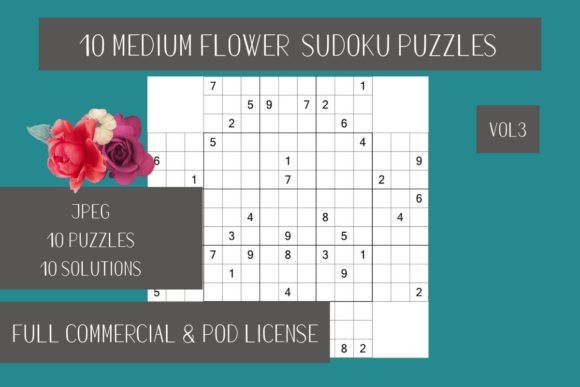
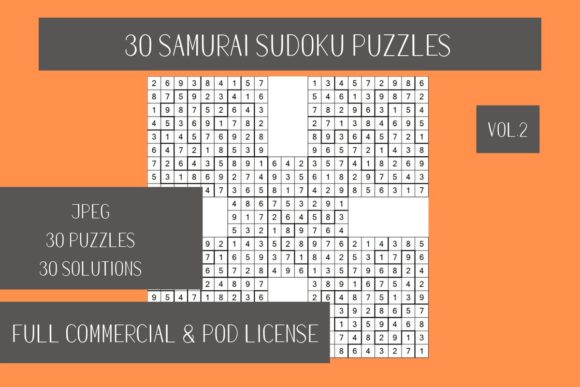
To fully appreciate the utility of 30 Samurai Sudoku Puzzles Vol.2, one must first understand the mechanics that distinguish Samurai Sudoku from its traditional counterpart. While standard Sudoku relies on a single 9x9 grid, Samurai Sudoku consists of five overlapping sudoku grids arranged in a cross-like pattern. The standard sudoku rules apply to each individual 9x9 grid: every row, column, and 3x3 box must contain the digits 1 through 9 without repetition. However, the complexity arises in the four overlapping regions where two grids intersect.
In these shared zones, the numbers must satisfy the rules for both grids simultaneously. This interdependence means that a solver cannot treat each grid as an isolated island; progress in one section often unlocks clues in another. This specific volume offers a medium level of difficulty, which is particularly significant for this format. Medium-difficulty Samurai puzzles typically require intermediate logical techniques such as naked pairs, hidden singles, and pointing pairs across the overlapping boundaries, without resorting to the exhaustive guessing or advanced chaining methods required for expert levels. This makes the set accessible to a broad audience while still providing a satisfying mental workout.
Technical Specifications for Professional Use
For business owners, self-publishers, and educators, the technical quality of puzzle assets is just as important as the logical validity of the grids. 30 Samurai Sudoku Puzzles Vol.2 is delivered as a digital download comprising high-resolution files optimized for print production. Understanding these specifications helps determine suitability for various projects.
- Resolution and Dimensions: Each file measures 2080×2080 pixels. This square aspect ratio provides ample white space around the five-grid layout, which is crucial for maintaining readability when printed in books or worksheets.
- DPI Rating: The images are rendered at 96 dpi. While commercial offset printing often targets 300 dpi, 96 dpi is generally sufficient for digital viewing, web-based activity sheets, and home or office printing on standard laser or inkjet printers. For mass-market paperback publishing, users may wish to test print a sample to ensure line crispness meets their specific quality standards.
- File Format: The puzzles are provided as JPEG files. This universal format ensures compatibility with virtually all design software, word processors, and e-reader platforms.
- No Watermarks: A critical feature for commercial users is the absence of watermarks. This allows for seamless integration into paid products, newsletters, or educational materials without requiring additional editing or licensing clearance.
Applications for Content Creators and Publishers
The primary value proposition of this collection extends beyond personal solving. For creators in the niche publishing market, sourcing original, error-free Samurai Sudoku can be time-consuming and expensive. Generating valid five-grid puzzles algorithmically requires specialized software and rigorous testing to ensure a unique solution exists. By utilizing 30 Samurai Sudoku Puzzles Vol.2, creators can bypass the generation phase and focus on layout and marketing.
Activity Books and KDP Publishing
Authors creating puzzle books for Amazon KDP or similar platforms can use these files as core content. Because the set includes 30 distinct puzzles with corresponding solutions, it forms a complete chapter or a standalone mini-book. The medium difficulty level is ideal for "Brain Training" or "Mindfulness Puzzle" genres, which target adults looking for relaxation rather than frustration. When incorporating these into a book, ensure your trim size accommodates the 2080px width to prevent the outer grids from being cropped during the binding process.
Educational and Cognitive Resources
Educators and therapists working with older adults or students developing logical reasoning skills will find this set particularly useful. The overlapping nature of Samurai Sudoku enhances spatial awareness and working memory more effectively than standard grids. Teachers can print these files directly for classroom handouts or laminate them for reusable dry-erase activities. The inclusion of separate solution files simplifies grading and allows for self-directed learning stations.
Guidance for Personal Solvers and Hobbyists
If you are acquiring 30 Samurai Sudoku Puzzles Vol.2 strictly for personal enjoyment, the digital format offers flexibility that physical books cannot match. You can solve them on a tablet using a stylus-compatible PDF reader, print only the puzzles you wish to tackle that day, or adjust the print scaling to fit your preferred paper size. The medium difficulty rating suggests that these puzzles are best approached with patience. Unlike easy puzzles that can be solved by scanning for missing numbers, these will likely require pencil marks and candidate elimination.
Solvers should also note that the five-grid structure changes the pacing of the solve. It is common to hit a wall in one grid, only to find the breakthrough by switching attention to a completely different corner of the Samurai formation. This non-linear solving path is part of the appeal and distinguishes the experience from completing five separate standard Sudokus.
Evaluating Suitability and Practical Considerations
Before integrating 30 Samurai Sudoku Puzzles Vol.2 into your workflow or routine, consider the following factors to ensure alignment with your needs:
- Volume Requirements: With 30 puzzles, this set is substantial for personal use but may serve as a supplement rather than a complete inventory for a full-length commercial puzzle book (which often contains 50–100+ puzzles). Plan accordingly if building a larger product.
- Print Quality Expectations: As noted, the 96 dpi specification is versatile but not archival-grade. If your project demands ultra-high definition lines for glossy art paper, verify samples first. For matte paper, newsprint, or digital screens, the resolution is typically optimal.
- Difficulty Consistency: "Medium" is a subjective term in the puzzle community. These puzzles adhere to standard definitions of medium complexity for Samurai formats, but individual perception varies. Reviewers and creators should solve a few samples to calibrate expectations before marketing them to a specific demographic.
- Licensing Terms: Always verify the specific license agreement accompanying the download. While the lack of watermarks implies commercial usability, confirming whether attribution is required or if there are limits on print runs protects your business from future compliance issues.
Maximizing the Value of Your Puzzle Collection
Whether used for cognitive maintenance, classroom engagement, or commercial publication, 30 Samurai Sudoku Puzzles Vol.2 represents a practical intersection of entertainment and utility. The five-grid overlapping format provides a richer problem-solving experience than traditional Sudoku, while the digital delivery model offers unprecedented flexibility for adaptation and reuse.
For creators, the ready-to-use, watermark-free JPEGs streamline production workflows and reduce overhead. For solvers, the medium difficulty curve offers a sustainable challenge that promotes long-term engagement without burnout. By understanding the technical specifications, structural nuances, and appropriate applications outlined above, users can confidently leverage this resource to meet their specific goals. Ultimately, the value of any puzzle collection lies not just in the grids themselves, but in how effectively they serve the needs of the person holding the pencil—or the mouse.