Evaluating the 2021 Planner Interior for Self-Publishing
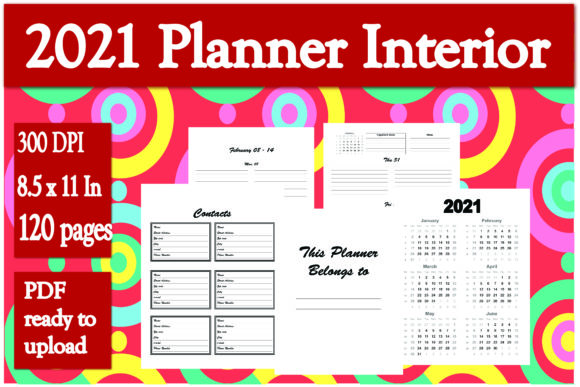
The 2021 Planner Interior is a pre-formatted digital asset designed specifically for self-publishers and low-content book creators. This product serves as a foundational template for producing physical planners through print-on-demand (POD) platforms. It includes a PDF file ready for upload, a complete 2021 calendar, contact name pages, and spans 120 pages at standard 8.5 x 11 inch dimensions with 300 DPI resolution. For entrepreneurs in the self-publishing space, evaluating this interior requires understanding how its specific features align with business goals, platform requirements, and market expectations.
Understanding the Product Specifications
Before integrating the 2021 Planner Interior into a publishing workflow, it is necessary to examine the technical specifications against industry standards. The 8.5 x 11 inch dimension is the most common size for productivity planners and academic organizers on major POD platforms. This size offers ample writing space, which is often a primary selling point for customers seeking functional organization tools rather than pocket-sized notebooks.
The resolution of 300 DPI is a critical benchmark. In print publishing, anything below 300 DPI risks appearing pixelated or blurry, particularly with fine lines used in calendar grids and table borders. This product meets the professional standard for crisp printing. The page count of 120 pages strikes a balance between utility and production cost. A 120-page planner provides sufficient content for monthly calendars, weekly spreads, and note sections without pushing the spine width to a point where text wrapping becomes difficult or printing costs erode profit margins significantly.
Strategic Value for Self-Publishers
The primary reason self-publishers evaluate this type of interior is time efficiency. Creating a 120-page planner from scratch involves significant design hours, including setting up master pages, ensuring consistent margins, generating accurate 2021 dates, and formatting contact lists. The 2021 Planner Interior eliminates the layout phase entirely. This allows publishers to focus resources on cover design, keyword research, and marketing strategies rather than internal formatting.
Furthermore, the inclusion of a "PDF file ready to upload" reduces technical friction. Many new publishers struggle with bleed settings, gutter margins, and color profiles. A pre-validated PDF mitigates the risk of file rejection during the automated review process on platforms like Amazon KDP or Lulu. For those building a catalog of seasonal products, having a reliable, standardized interior accelerates the listing process and ensures consistency across different cover variations.
Benefits and Practical Advantages
Beyond time savings, this interior offers structural benefits that support a sustainable publishing model:
- Accuracy Assurance: Calendar errors are a common source of negative reviews in the planner niche. Using a verified 2021 calendar template removes the liability of manual date entry errors.
- Cost Predictability: With a fixed 120-page count, publishers can calculate exact printing costs and royalties before listing. This facilitates precise pricing strategies to maintain healthy margins.
- Functional Utility: The inclusion of Contact Names adds value beyond simple scheduling. This transforms the product from a basic calendar into a comprehensive organizer, potentially justifying a higher price point compared to single-function alternatives.
- Scalability: Standardized interiors allow for rapid A/B testing of covers. Publishers can test multiple cover designs against the same high-quality interior to determine which aesthetic resonates with the target audience without redesigning the book block.
Tradeoffs and Limitations
While the 2021 Planner Interior offers convenience, objective evaluation requires acknowledging its limitations. The most significant tradeoff is lack of exclusivity. As a pre-made template, this interior may be used by other publishers. In a saturated market, identical interiors can lead to duplicate content flags or make it difficult to differentiate a product based on internal features alone. Success with this product relies heavily on unique cover design and targeted niche positioning.
Additionally, the fixed structure limits customization. If a specific sub-niche requires specialized tracking pages (e.g., fitness logs, budget trackers, or lesson planning), this generic interior may not suffice. Publishers must decide whether a general-purpose planner aligns with their brand or if a specialized, custom-designed interior would better serve their specific audience segment.
There is also the temporal limitation. As a 2021-specific product, its commercial viability is now historical. Evaluators looking at this product today should do so primarily to assess the quality of the supplier’s templates for current or future years, or for archival/educational purposes regarding 2021 planning trends.
Situational Fit Assessment
Determining whether this interior is appropriate depends on the publisher's current stage and objectives. The 2021 Planner Interior is a strong fit for:
- New Publishers: Those learning the POD process who need a guaranteed-compliant file to understand platform workflows without risking design errors.
- Cover Designers: Creators whose strength lies in visual aesthetics rather than typography or layout, allowing them to leverage existing functional structures.
- Catalog Expanders: Established publishers needing to quickly add a standard planner variant to complement existing niche-specific journals.
- Budget-Conscious Startups: Entrepreneurs validating market demand before investing in custom interior design services.
Conversely, alternatives may be worth considering when:
- Brand Differentiation is Critical: If the business model depends on proprietary layouts or unique user experiences, a custom interior is necessary.
- Premium Pricing Strategy: High-ticket planners typically require bespoke interiors to justify the cost; generic templates may undermine perceived value.
- Niche Specialization: Target audiences with specific organizational needs (e.g., nurses, teachers, real estate agents) often require tailored content that generic planners cannot provide.
Decision-Making Framework
When evaluating the 2021 Planner Interior or similar assets, publishers should apply a practical decision matrix. First, verify platform compliance independently; never assume a third-party file is error-free. Download the PDF and check margins, bleed, and date accuracy against current platform guidelines. Second, conduct competitive analysis. Search for other planners using similar interiors and assess whether your cover design and metadata strategy can realistically compete. Third, calculate true profitability. Factor in not just printing costs, but also advertising spend required to distinguish a non-exclusive interior in search results.
Finally, consider the long-term asset value. Does acquiring this interior grant rights for modification? Can the layout be adapted for future years? Products that offer editable source files alongside print-ready PDFs provide greater long-term ROI than static documents. The 2021 Planner Interior represents a functional tool for specific publishing scenarios. Its value is derived not from uniqueness, but from reliability, compliance, and efficiency. Publishers who align their expectations with these attributes will find it a practical component of a broader self-publishing strategy, while those seeking differentiation should view it as a baseline reference rather than a final solution.