Scripting Journal for KDP: A Practical Workflow for Low-Content Publishing
Creating a successful low-content book on Amazon KDP requires more than just uploading a generic template; it demands a product that solves a specific problem for a targeted audience. The Scripting Journal for KDP serves as a comprehensive foundational asset for publishers, creators, and entrepreneurs looking to enter the manifestation and gratitude journaling niche. Rather than starting from a blank canvas, this resource provides a pre-structured, tested, and editable framework that streamlines the production process. It fits into the broader publishing workflow as a customizable base layer, allowing you to focus on branding, keyword research, and marketing rather than spending dozens of hours formatting interior pages.
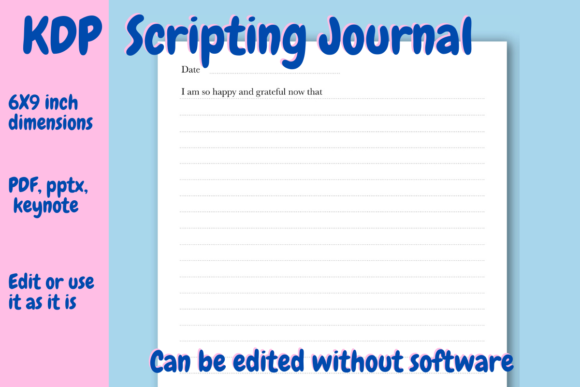
This journal template is designed specifically for the 6x9 inch trim size, which is currently one of the most popular dimensions for personal development books. The interior features a black and white design with no bleed, optimizing printing costs while maintaining a professional aesthetic. With a total of 120 pages and a calculated printing cost of approximately $2.29 USD, the financial margins are built into the file structure. For publishers managing multiple titles or testing new niches, having a verified, KDP-preview-tested document eliminates the technical guesswork and reduces the risk of rejection during the upload phase.
Integrating the Template Into Your Publishing Pipeline
The Scripting Journal for KDP is not merely a static PDF; it is a dynamic project file available in PPTX, Keynote, and PDF formats. This multi-format availability ensures compatibility across different workflows and operating systems. For professionals who rely on specific design ecosystems, the native Keynote and PowerPoint files allow for deep customization. However, the true utility lies in its accessibility for those without paid software licenses. The PPTX file has been specifically formatted for Google Slides, meaning anyone with a free Gmail account can upload, edit, and export the journal without purchasing additional tools.
In a practical publishing workflow, this template acts as the bridge between concept and execution. Before you begin editing, the file serves as a feasibility test. You can review the 117 scripting pages and the structural elements to determine if the "I am so happy and grateful now that" prompt aligns with your target customer's intent. During the creation phase, the editable nature of the file allows for rapid iteration. If market research suggests that customers prefer more introductory content or fewer daily pages, you can adjust the page count immediately. After the project is complete, the standardized formatting ensures that future volumes or series extensions maintain visual consistency, which is crucial for building brand recognition on Amazon.
Customization Without Technical Barriers
Efficiency in low-content publishing often comes down to how quickly you can adapt a base asset to meet specific niche requirements. The Scripting Journal for KDP facilitates this through intuitive editing controls. The instruction set is straightforward: to increase the volume of specific sections, such as adding more reflection pages or monthly reviews, you simply right-click and duplicate the relevant slides. Conversely, if you need to lower printing costs or create a shorter, lower-priced entry point product, you can delete extra pages with equal ease.
This flexibility is vital for price testing and margin optimization. Since the base printing cost sits at $2.29 for 120 pages, removing ten pages might drop the cost enough to allow for a more competitive list price while maintaining your royalty targets. Alternatively, adding twenty pages could justify a premium price point for a "deluxe" edition. Because the document uses standard dotted lines and consistent headers, these modifications do not disrupt the overall layout or require manual realignment. The date space and affirmation prompt at the top of each page remain anchored, ensuring that even heavily edited versions retain their functional integrity.
Understanding the Interior Structure and User Experience
A journal is only successful if the end-user finds it intuitive and valuable. The interior of this Scripting Journal for KDP is engineered for daily engagement. Each of the 117 scripting pages follows a deliberate cognitive flow. The space for the date at the top grounds the user in the present moment, while the fixed phrase “I am so happy and grateful now that” serves as a psychological trigger. This specific phrasing is central to the scripting method, encouraging users to write in the present tense as if their desires have already manifested. As a publisher, understanding this mechanism helps you write better book descriptions and ad copy that resonate with people actively practicing this technique.
The use of dotted lines rather than solid lines is a subtle but important design choice. Dotted lines provide guidance for handwriting without feeling restrictive, accommodating various writing styles and pen types. This attention to user experience reduces friction for the customer. When integrating this template into your catalog, consider how this interior interacts with your cover design. The clean, minimalist black and white interior pairs well with both vibrant, artistic covers and understated, typographic designs. Because the interior is no-bleed, you have a safe margin that prevents text from being trimmed, reducing customer complaints regarding cut-off content.
Workflow Compatibility and File Management
For teams or solo publishers managing assets across devices, file compatibility is a logistical necessity. The inclusion of PDF, PPTX, and Keynote files covers the vast majority of use cases. The PDF serves as the final proofing document and the upload-ready file for KDP. The PPTX and Keynote files serve as the master source files. When working in Google Slides, the process is seamless: upload the PPTX, make your edits using familiar slide-based controls, and download as a PDF when ready to publish.
This workflow also supports collaboration. If you work with virtual assistants or designers, you can share the Google Slides link directly without transferring large files or worrying about version control. They can add branding elements, modify the copyright page with your brand name, or adjust the title page typography without needing access to Adobe InDesign or Affinity Publisher. This democratization of the design process allows small business owners and freelancers to scale their output without increasing overhead costs associated with specialized software training or licensing.
Strategic Implementation for Long-Term Growth
Using the Scripting Journal for KDP effectively requires viewing it as part of a larger business strategy rather than a one-off upload. Preparation involves validating the niche before customizing the file. Use tools like Publisher Rocket or Amazon search suggestions to verify demand for "scripting journals," "manifestation diaries," or "gratitude scripting." Once validated, customize the title page and copyright page to reflect your specific brand identity. Adding your brand name to the copyright page is a simple step that establishes ownership and professionalism.
Quality control is another critical factor. Even though the document has been tested on the KDP previewer, you should always order a physical proof after making significant edits. Screen resolution differs from print output, and verifying the opacity of the dotted lines and the spacing of the header text ensures the final product meets customer expectations. Consistency across your catalog builds trust; if you release a series of journals, use this template’s master file to ensure margins, fonts, and line spacing remain identical across all volumes.
Optimizing for Efficiency and Profitability
The economic viability of low-content books relies heavily on unit economics. With a printing cost of $2.29, this 120-page journal offers a balanced ratio of perceived value to production expense. When planning your pricing strategy, consider how the editable page count influences your bottom line. If you are running ads, a lower printing cost allows for a lower break-even ROAS (Return on Ad Spend). By deleting non-essential pages, you can create a leaner version optimized for paid traffic, while keeping the full 120-page version for organic sales where higher perceived value drives conversions.
Furthermore, the time saved by using a pre-formatted Scripting Journal for KDP translates directly to opportunity cost. Instead of spending 20 hours designing interiors, you can spend that time researching keywords, designing high-converting covers, or building an email list. The template handles the repetitive structural work, freeing up mental bandwidth for creative and strategic tasks. Whether you are an educator creating resources for students, a coach providing tools for clients, or a publisher scaling a portfolio, this asset integrates into your workflow as a force multiplier.
Ultimately, the value of this resource lies in its balance of structure and flexibility. It provides the technical safety net of a KDP-tested file while offering the creative freedom to build a unique product. By leveraging the Google Slides compatibility, understanding the psychological design of the scripting prompts, and strategically managing page counts for margin optimization, you can transform this template into a sustainable component of your digital publishing business. The focus shifts from struggling with formatting to executing a clear, profitable publishing strategy.