Notes KDP Interior: Streamlining Low-Content Publishing
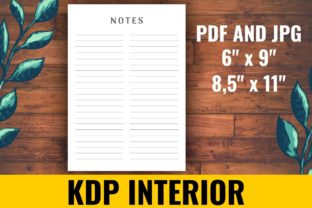
Creating a successful low-content book on Amazon requires more than just a compelling cover; the interior experience dictates whether a customer becomes a repeat buyer or leaves a negative review. For publishers and creators managing multiple titles, designing unique interiors from scratch for every project is often unsustainable. This is where a dedicated Notes KDP Interior solution becomes essential. By utilizing pre-formatted templates that include 100 pages in both PDF and JPG formats, creators can bypass the technical hurdles of layout design and focus entirely on niche research and marketing strategy.
The availability of these interiors in two distinct size versions, 6x9 inch and 8.5x11 inch, addresses the two most dominant categories in the notebook market. The dual-format delivery ensures compatibility with various publishing workflows, whether you are uploading directly to KDP or using third-party formatting tools. Understanding how to leverage these specific assets can significantly reduce production time while maintaining the professional quality necessary to compete in saturated markets.
Accelerating Production Without Sacrificing Quality
Time is often the most scarce resource for independent publishers and freelancers. Designing a 100-page interior involves setting margins, establishing bleed areas, creating consistent line weights, and ensuring page numbers align correctly. Even for experienced designers, this process consumes hours that could be better spent on keyword research or ad optimization. A standardized Notes KDP Interior eliminates this repetitive labor.
When you utilize a ready-made template containing 100 pages, you are not merely saving time; you are standardizing quality. Professional templates account for the specific gutter requirements of Amazon’s printing process, preventing text or lines from being swallowed by the binding. This technical precision is difficult to maintain when rushing through manual design. For entrepreneurs scaling a publishing business, this consistency allows for rapid portfolio expansion. You can test five new niches in the time it previously took to design one interior, allowing data rather than guesswork to drive your business decisions.
Navigating Size Selections for Target Audiences
Choosing between the available 6x9 inch and 8.5x11 inch versions is a strategic decision that should be based on user intent rather than personal preference. Each size serves a distinct functional purpose, and understanding this distinction improves the relevance of your product.
- 6x9 Inch Portability: This trim size is ideal for journals, daily planners, and travel notebooks. Users in this category prioritize portability and discretion. If your target audience includes commuters, students, or professionals who need to capture thoughts on the go, the 6x9 Notes KDP Interior is the appropriate choice. It fits easily into bags and feels like a personal accessory rather than a textbook.
- 8.5x11 Inch Utility: The larger format caters to users requiring ample space for detailed work. This size is standard for academic note-taking, music composition, technical sketching, and large-print accessibility. Educators, musicians, and seniors often prefer this dimension because it reduces eye strain and provides room for expansive handwriting. Selecting this version signals that the book is a workspace tool rather than a pocket companion.
By matching the physical dimensions of your Notes KDP Interior to the specific use case of your niche, you increase the perceived value of the book. A mismatch here, such as offering a tiny 6x9 ledger for accounting, leads to returns and poor reviews regardless of how beautiful the cover is.
Technical Versatility Through Dual File Formats
The inclusion of both PDF and JPG formats within the same package addresses a common friction point in digital publishing. While PDF is the industry standard for print-ready files, having high-resolution JPG options offers flexibility that benefits creators working across different platforms and software environments.
The PDF file is typically the primary asset for KDP upload. It preserves vector quality, ensuring that lines remain crisp at any zoom level and file sizes remain manageable. However, the JPG versions serve critical secondary functions. Marketers often need individual page images to create mockups for social media advertising or Amazon A+ Content. Extracting high-quality images from a secured PDF can be technically challenging and may result in compression artifacts. Having native JPG files simplifies the creation of promotional materials, allowing you to showcase the interior layout clearly to potential buyers before they purchase.
Furthermore, some third-party publishing aggregators or local print-on-demand services handle image uploads differently than Amazon. Having both formats ensures that your Notes KDP Interior remains versatile enough to support multi-platform distribution strategies without requiring additional conversion work.
Strategic Customization Within Pre-Made Frameworks
A common concern among serious publishers is that pre-made interiors lead to duplicate content penalties or generic products. While it is true that uploading unaltered templates carries risks, a high-quality Notes KDP Interior is designed as a foundation, not a final product. The 100-page structure provides the necessary bulk and formatting compliance, but the creative differentiation happens in the details.
Consider adding niche-specific headers, inspirational quotes, or instructional prompts to the first few pages. Even simple modifications, such as adjusting the opacity of the lines or adding a subtle watermark, can transform a generic template into a branded experience. Because the base file already handles the complex margin and bleed calculations, you can safely experiment with these surface-level customizations without breaking the print specifications. This hybrid approach balances efficiency with uniqueness, satisfying both algorithmic requirements for originality and customer expectations for specialized content.
Evaluating Fit and Limitations for Professional Results
While a pre-formatted Notes KDP Interior offers significant advantages, it is important to recognize where this solution fits within a broader publishing strategy. These templates excel in functional categories like lined journals, graph paper notebooks, and basic planners. They are less suitable for highly interactive books, complex activity books, or guided journals that require varying layouts throughout the manuscript.
If your concept relies on unique page-by-page progression, a static 100-page repeating template will feel inadequate to users. In such cases, custom design remains necessary. Additionally, publishers targeting premium price points must ensure that the paper weight and finish selected during the KDP setup complement the interior density. Standard color printing on white paper works well for most notes interiors, but if you modify the template with heavy graphics, you must verify that bleed-through will not occur.
Creators should also be mindful of licensing terms. Ensure that the specific Notes KDP Interior you acquire grants commercial rights for unlimited use. Ethical publishing involves respecting intellectual property while building your own sustainable asset library. When used correctly within these boundaries, these resources act as force multipliers for your creative output.
Supporting Diverse Creator Goals
The utility of these interiors extends beyond traditional self-publishers. Educators can use the 8.5x11 version to create custom classroom worksheets or student reflection journals without spending budget on expensive design software. Freelancers and coaches can develop branded merchandise for clients, turning a simple notebook into a tangible extension of their service offering. Small business owners can produce internal logbooks or customer feedback journals that maintain brand consistency.
For hobbyists and artists, the availability of clean, professionally formatted pages removes the barrier to entry for sharing their organizational systems with a wider community. Instead of struggling with InDesign or Canva alignment issues, they can focus on curating the content that makes their specific method valuable. Ultimately, the goal of utilizing a Notes KDP Interior is to shift energy away from technical production and toward value creation. By solving the formatting problem definitively, these resources enable creators to build meaningful connections with their audience through products that are both functional and professionally presented.