Streamlining Self-Publishing: A Complete Guide to Using a KDP Interior Inventory Log
In the rapidly expanding world of self-publishing, success is often determined not just by creative talent, but by organizational efficiency. For authors and publishers utilizing Amazon’s Kindle Direct Publishing (KDP) platform, managing low-content and medium-content books requires a systematic approach. One of the most essential tools for this specific niche is the KDP Interior Inventory Log. Whether you are a seasoned publisher with hundreds of titles or a beginner launching your first journal, understanding how to leverage a dedicated inventory log can transform your publishing workflow from chaotic to streamlined.
This guide explores the fundamental purpose of inventory logs in self-publishing, why they are critical for business scalability, and how to effectively utilize a ready-to-print interior pack designed specifically for KDP creators. By moving beyond simple tracking and embracing structured data management, publishers can protect their intellectual property, optimize their marketing strategies, and maintain a professional standard in an increasingly competitive marketplace.
The Foundation of Low-Content Publishing Organization
To understand the value of a specialized inventory log, one must first understand the unique challenges of low-content publishing. Unlike traditional novels where an author might release one or two titles a year, low-content publishers often manage portfolios ranging from fifty to several hundred active listings. These include notebooks, planners, trackers, coloring books, and logbooks. Without a centralized system, tracking metadata becomes nearly impossible.
A KDP Interior Inventory Log serves as the master database for your publishing business. It is distinct from the sales reports provided by Amazon. While Amazon tells you what sold, an inventory log tells you what exists, where it lives, and how it is configured. This distinction is vital. Sales data is reactive; inventory data is proactive. It allows you to audit your catalog, identify gaps in your niche research, and ensure that every book listed on Amazon has a corresponding backup file and accurate metadata record on your end.
Why Digital Files Alone Are Not Enough
A common misunderstanding among new publishers is the assumption that their KDP dashboard or cloud storage folder structure is sufficient for inventory management. While these are necessary components, they lack the relational context required for business growth. A folder named "Floral Journal" does not tell you the trim size, page count, keyword set, or publication date at a glance. You would have to open the file or check the live listing to verify details.
A dedicated log consolidates this information into a single view. This is particularly relevant when dealing with customer service inquiries, updating editions, or planning advertising campaigns. When you need to quickly reference which version of a planner uses a specific interior layout, a physical or printable digital log provides immediate answers without navigating through multiple software interfaces.
Analyzing the Ready-to-Upload Inventory Pack
Efficiency in self-publishing also extends to the tools you use to manage your business. Creating a custom inventory tracker from scratch consumes valuable time that could be spent on research and design. This is where pre-formatted solutions become invaluable. The specific KDP Interior Inventory Log pack discussed here is engineered for immediate utility, removing technical friction from the organizational process.
Technical Specifications and Usability
When selecting or utilizing an inventory log for KDP, format compatibility is paramount. This specific resource is designed with the platform's strict printing guidelines in mind. The pack includes two distinct variations to suit different workflows:
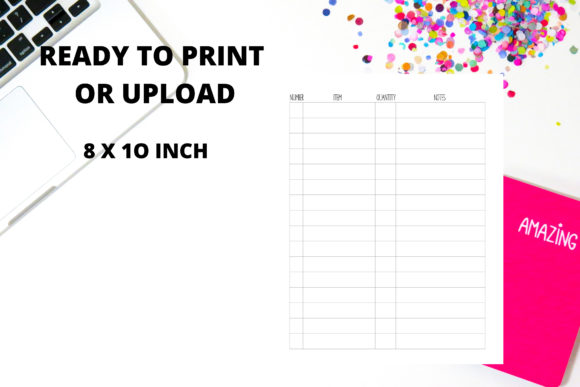
- 100-Page PDF File (8 x 10 inches): This is the core component for high-volume publishers. At 100 pages, it offers substantial capacity for recording extensive catalog details. The 8 x 10 inch trim size is a versatile standard in low-content publishing, providing ample writing space while remaining cost-effective to print if you choose to keep a physical binder.
- Single Page JPEG and PDF: Not every project requires a full book. The inclusion of a standalone 8 x 10 inch file allows for modular tracking. This is ideal for testing new niches, tracking seasonal releases, or for publishers who prefer to keep separate logs for different categories (e.g., one log for coloring books, another for financial planners).
Crucially, this product comes with no watermarks of any kind. In the context of KDP interiors, this is a non-negotiable feature. Watermarked files cannot be used commercially or professionally. A clean, unbranded interior ensures that if you decide to print this log for your own office use, or even adapt it as a base for your own personal tracking system, the result is pristine and professional.
Strategic Data Points to Track
Having the log is only the first step; knowing what to record determines its effectiveness. An educational approach to inventory management suggests tracking more than just titles. To maximize the utility of your 100-page log, consider organizing your entries around the following semantic clusters:
- Core Metadata: Title, subtitle, author/pen name, and ISBN-13. These are the immutable identifiers of your product.
- Physical Specifications: Trim size, page count, paper type (white vs. cream), and cover finish (matte vs. glossy). Discrepancies here are the leading cause of printing errors and rejected uploads.
- Keyword and Category Strategy: Record the seven backend keywords and the two BISAC categories selected for each title. Over time, this historical data helps you analyze which keyword combinations correlate with higher sales, turning your log into a marketing analytics tool.
- File Versioning: Note the filename and location of the source interior and cover files. If you update a cover six months after publication, your log should reflect that change to prevent accidental reversion to old files during future updates.
- Pricing and Royalty Notes: Track your list price across different marketplaces. This is especially helpful when running promotions or adjusting prices based on printing cost changes.
Integrating Analog Tracking in a Digital Business
In an era dominated by spreadsheets and project management software, the choice to use a printable PDF inventory log may seem counterintuitive. However, there is significant practical relevance in maintaining an analog or offline record for digital assets.
Risk Mitigation and Redundancy
Digital platforms are subject to change. Accounts can be suspended, algorithms shift, and software subscriptions lapse. A printed or locally stored PDF inventory log acts as an insurance policy for your intellectual property. It ensures that regardless of external platform volatility, you retain complete ownership and knowledge of your catalog. This redundancy is a hallmark of professional business continuity planning.
Cognitive Benefits of Handwritten Logging
For many creatives, the act of physically writing down book details reinforces memory and intentionality. When you manually log a new title, you are forced to slow down and verify details that might be glossed over during a rapid copy-paste session into a spreadsheet. This tactile engagement can reduce errors and increase mindfulness regarding the quality of each publication. Furthermore, having a physical reference on your desk eliminates the distraction of opening a browser tab, keeping you focused on the administrative task at hand.
Best Practices for Implementation
To get the most out of your KDP Interior Inventory Log, establish a consistent routine. Treat the logging process as the final step of your publishing checklist. Do not consider a book "published" until it has been recorded in your master log. This discipline prevents the accumulation of untracked titles that eventually become orphaned assets.
Additionally, utilize the single-page JPEG/PDF option for quick capture. If you are brainstorming or doing initial niche validation, use the single sheet to jot down potential titles and specs before committing them to the main 100-page volume. This tiered approach keeps your primary log clean and reserved for confirmed, live publications.
Finally, remember that this log is a living document. As your understanding of the KDP ecosystem deepens, feel free to annotate the margins or add supplementary notes. The simplicity of the interior is its strength; it provides structure without rigidity, allowing your organizational system to evolve alongside your publishing business.
Conclusion
The KDP Interior Inventory Log is more than a simple notebook; it is a foundational element of a sustainable self-publishing business. By providing a clean, watermark-free, and correctly formatted 8 x 10 inch template in both comprehensive and single-page variations, this resource addresses the specific technical and operational needs of modern publishers. Whether used as a digital reference or a printed companion, it bridges the gap between creative production and business management. Embracing such tools allows authors to move beyond the chaos of disorganization and build a resilient, scalable catalog that stands the test of time in the dynamic world of digital publishing.